Published
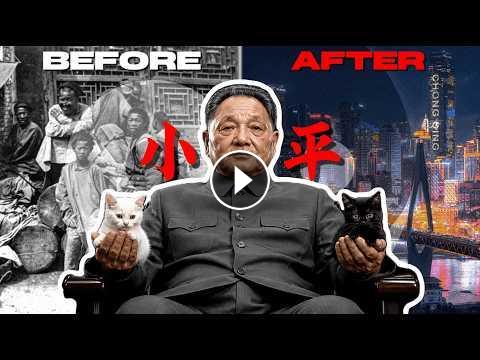
How did China go from being one of the poorest countries in the world to becoming a global superpower? In this documentary, we explore the story of Deng Xiaoping after the death of Mao Zedong: the man behind the Chinese economic miracle, China’s Reform and Opening Up, and the rise of China from the largest slum on Earth to the superpower it is today.
In 1976, China was one of the poorest countries on Earth. After the Great Leap Forward, the Cultural Revolution, and Mao Zedong’s death, the Chinese Communist Party inherited a country scarred by famine, political repression, illiteracy, and economic ruin.
Deng Xiaoping understood that China’s real problem was not only economic, but ideological. To reform China, he first had to criticize Mao’s legacy without destroying the legitimacy of the Communist Party. So he used Mao’s own words against Mao’s legacy: “seek truth from facts” and “practice is the sole criterion for testing truth.” If a policy worked, it stayed. If it failed, it had to change.
Through this logic, modern China was born. Deng summed up his vision with a phrase that would define an entire era: “It doesn’t matter whether the cat is black or white, as long as it catches mice.” With this pragmatism, he reopened schools and universities, restored the Gaokao, promoted education, sent students abroad, and forced China to learn from the world: from Japan, South Korea, Taiwan, Hong Kong, Singapore, and the United States.
Through Reform and Opening Up, Deng created four Special Economic Zones: Shenzhen, Zhuhai, Shantou, and Xiamen. These were small economic laboratories where China began experimenting with foreign investment, exports, factories, technology, markets, and local autonomy. Instead of imposing a single formula from Beijing on the entire country, he encouraged local governments to test, fail, and replicate what worked. If an experiment failed, it was stopped. If it produced results, it was expanded. This was what Deng called “crossing the river by feeling the stones.”
In this documentary, we also explore how Deng negotiated the return of Hong Kong and Macau under the formula of “one country, two systems,” and how his reforms made China faster, more productive, and more open, while also making it more unequal, corrupt, and politically tense. That contradiction exploded in the Tiananmen protests of 1989, when students, workers, and intellectuals demanded political reform, freedom of speech, and an end to corruption.
After Tiananmen, the Party cracked down, the reforms lost momentum, and many inside the regime accused Deng of having pushed China into chaos. After the fall of the Soviet Union, China seemed on the verge of closing itself off again. But in 1992, old and fragile, yet still politically influential, Deng went on a journey through southern China to see how much the country had grown and to convince its leaders to keep reforming and opening up. This was the Southern Tour.
In Shenzhen and other southern cities, Deng defended Reform and Opening Up. This simple journey by an old man on an adventure to discover his country restored investor confidence and helped save China from closing itself off once again.
This is the story of Deng Xiaoping: the man who transformed Mao’s China into modern China, opened the path to the fastest economic growth in contemporary history, and helped turn China into the global superpower it is today.
Writer: Vlad Racovita
Editor: Santhi Christina
Tags: Deng Xiaoping, Deng Xiaoping documentary, Chinese economic miracle, China miracle, how China escaped poverty, how China became a superpower, China Reform and Opening Up, China economic reform, China after Mao, Mao to Deng China, Deng Xiaoping modern China, architect of modern China, socialism with Chinese characteristics, Shenzhen, Special Economic Zones, Southern Tour, Great Leap Forward, Cultural Revolution, Tiananmen
#History #DengXiaoping #China
In 1976, China was one of the poorest countries on Earth. After the Great Leap Forward, the Cultural Revolution, and Mao Zedong’s death, the Chinese Communist Party inherited a country scarred by famine, political repression, illiteracy, and economic ruin.
Deng Xiaoping understood that China’s real problem was not only economic, but ideological. To reform China, he first had to criticize Mao’s legacy without destroying the legitimacy of the Communist Party. So he used Mao’s own words against Mao’s legacy: “seek truth from facts” and “practice is the sole criterion for testing truth.” If a policy worked, it stayed. If it failed, it had to change.
Through this logic, modern China was born. Deng summed up his vision with a phrase that would define an entire era: “It doesn’t matter whether the cat is black or white, as long as it catches mice.” With this pragmatism, he reopened schools and universities, restored the Gaokao, promoted education, sent students abroad, and forced China to learn from the world: from Japan, South Korea, Taiwan, Hong Kong, Singapore, and the United States.
Through Reform and Opening Up, Deng created four Special Economic Zones: Shenzhen, Zhuhai, Shantou, and Xiamen. These were small economic laboratories where China began experimenting with foreign investment, exports, factories, technology, markets, and local autonomy. Instead of imposing a single formula from Beijing on the entire country, he encouraged local governments to test, fail, and replicate what worked. If an experiment failed, it was stopped. If it produced results, it was expanded. This was what Deng called “crossing the river by feeling the stones.”
In this documentary, we also explore how Deng negotiated the return of Hong Kong and Macau under the formula of “one country, two systems,” and how his reforms made China faster, more productive, and more open, while also making it more unequal, corrupt, and politically tense. That contradiction exploded in the Tiananmen protests of 1989, when students, workers, and intellectuals demanded political reform, freedom of speech, and an end to corruption.
After Tiananmen, the Party cracked down, the reforms lost momentum, and many inside the regime accused Deng of having pushed China into chaos. After the fall of the Soviet Union, China seemed on the verge of closing itself off again. But in 1992, old and fragile, yet still politically influential, Deng went on a journey through southern China to see how much the country had grown and to convince its leaders to keep reforming and opening up. This was the Southern Tour.
In Shenzhen and other southern cities, Deng defended Reform and Opening Up. This simple journey by an old man on an adventure to discover his country restored investor confidence and helped save China from closing itself off once again.
This is the story of Deng Xiaoping: the man who transformed Mao’s China into modern China, opened the path to the fastest economic growth in contemporary history, and helped turn China into the global superpower it is today.
Writer: Vlad Racovita
Editor: Santhi Christina
Tags: Deng Xiaoping, Deng Xiaoping documentary, Chinese economic miracle, China miracle, how China escaped poverty, how China became a superpower, China Reform and Opening Up, China economic reform, China after Mao, Mao to Deng China, Deng Xiaoping modern China, architect of modern China, socialism with Chinese characteristics, Shenzhen, Special Economic Zones, Southern Tour, Great Leap Forward, Cultural Revolution, Tiananmen
#History #DengXiaoping #China
- Catégories
- Musique kabyle
- Mots-clés
- Deng Xiaoping, Deng Xiaoping documentary, Chinese economic miracle

Soyez le premier à commenter cette vidéo.
Up Next
Autoplay
-
03:07

Cries of distress from Kabylia and urgent request for the protection of the Kabyle people-03/12/2021
-
09:19
|Thé fait maison pour perdre du poids Recette de perte de poids
-
39:03
Brutal murder: Destroying the tribal family for killing their young daughter by anonymous people
-
39:39
Préparation de la recette du thé pour maigrir,
-
1:14:49
répondez à vos questions sur le thé à la coriandre et ma fill elle est avec moi à la fin de la vidéo
-
06:23
"Manchmal weiß man nicht, wie man es machen soll. gesungen. & .getextet.Peter Eckstein Oberfranken.
-
05:06
Zehar Dhi China
-
36:53
It turned out that these two people intended to separate the engineer and the poor girl
-
05:06
Zehar Dhi China (Remastered 2023)
-
36:30
Shocking Shock: The murder of a nomadic widow by anonymous people in the rough mountain
-
03:58

Partir repartir (Album de 12 chansons)
-
31:44

السلسلة الامازيغية نا زعزي الموسم 1 الحلقة 3 الثالثة | Na Zaazi 1
-
06:53
Sadaoui Salah-Vidéo
-
32:37

السلسلة الامازيغية ثينيفيفث 2 الحلقة 26 السادسة والعشرون | Tinifift 2
-
31:23

السلسلة الامازيغية إخف ان لهنا الحلقة 4 الرابعة | Lxef n lahna
-
29:51
السلسلة الامازيغية نا زعزي الموسم 1 الحلقة 10 العاشرة | Na Zaazi 1
-
06:27

►salah sadaoui - chaabi algerien ⵣ
-
1:58:28

chinese zodiac jackie chan film complet en francais 2018
-
31:15

السلسلة الامازيغية إخف ان لهنا الحلقة 1 الأولى | Lxef n lahna
-
25:58
Le feuilleton kabyle Asirem épisode 17